


As ESG shifts from standardised reporting to board-level judgement under uncertainty, the real differentiator is no longer disclosure but governance quality and decision discipline. This article sets out why ESG risk now demands senior ownership - a theme that will be explored in depth at the #RISK Executive Forums, where carefully curated groups of decision-makers convene for practical, sector-specific discussions on how ESG is reshaping strategy, capital allocation and resilience across Financial Services, Healthcare & Life Sciences, Technology, and Energy & Utilities.
Executive summary
- ESG risks and opportunities are now material drivers of performance, resilience and competitiveness across sectors.
- Regulatory simplification has reduced standardised reporting, but it has not reduced underlying risk or market exposure.
- In this environment, competitive advantage depends less on formal compliance and more on governance quality: the ability to translate imperfect information into disciplined, forward-looking decisions.
1. ESG entered corporate strategy for economic, not ideological, reasons
ESG did not arrive in boardrooms because of ideology or political pressure. It arrived because executives, investors and risk leaders started to see risks and opportunities were no longer adequately captured by traditional financial indicators alone.
Issues such as climate exposure, access to critical resources, supply-chain fragility, governance failures, cyber incidents or social disruption were showing up in financial results (sometimes gradually, sometimes abruptly). Earnings volatility, asset impairments, rising insurance costs, shifts in the cost of capital, operational downtime or loss of market access are no longer theoretical outcomes. They are observable across sectors and geographies.
From a risk perspective, ESG sits alongside cyber risk, geopolitical risk or technological disruption. The origin may be extra-financial, but the impact is not. The real challenge has never been philosophical. It has always been practical: how to identify, assess and manage these factors with the same rigour applied to financial risks and opportunities.
This is not about replacing financial logic. It is about complementing it where traditional financial data is incomplete, backward-looking or slow to capture emerging exposure.
2. Sustainable finance reporting was designed as information infrastructure
Sustainable finance reporting (SFR) and related ESG frameworks were developed to respond to that challenge. Their purpose was straightforward: improve the quality of information available to markets by reducing information gaps between companies, investors and lenders.
When ESG information is used properly, it supports:
- more accurate identification and pricing of risk,
- better capital allocation decisions,
- more constructive dialogue between corporates, financiers and insurers,
- and, ultimately, greater resilience at both firm and system level.
Reporting itself was never meant to be the goal. It is a transmission mechanism. Where ESG data remains disconnected from governance and strategy, reporting quickly becomes heavy, costly and low-value. Where it is embedded into decision-making, disclosures tend to become more focused, more credible and easier to maintain.
It is also worth noting that the economics of reporting have changed. Technology now materially reduces the marginal cost of collecting, consolidating and disclosing ESG data for organisations that integrate it into their management information systems. For these actors, reporting friction is largely a short-term implementation issue, not a structural constraint.
This distinction helps explain why central banks, supervisors and insurers increasingly incorporate climate and environmental risks into stress testing, capital frameworks and supervision. The driver is financial stability and risk management, not values.

3. Competitiveness is shaped by predictability, not by the lowest standards
Concerns that ESG standards undermine competitiveness are often framed in terms of short-term cost and operational flexibility. That lens is incomplete.
From a strategic perspective, advanced economies rarely compete successfully by lowering standards. There will always be jurisdictions with fewer constraints, lower costs or more flexible rules. Europe is structurally unlikely to win a competition based on minimal requirements.
Its comparative advantage lies elsewhere: in predictability, coordination at scale and the ability to turn long-term constraints into strategic positioning. As a large consumer market, Europe still shapes investment and innovation through the standards it sets and enforces.
When designed well and applied consistently, standards act as economic infrastructure. They reduce uncertainty, support investment planning and enable innovation. From a risk perspective, what matters most to companies and investors is not the absolute level of regulation, but clarity, consistency and enforceability over time. Frequent reversals or prolonged ambiguity increase risk premiums and delay decisions.
Competing by progressively weakening standards (what could be described as ESG dumping) does not strengthen competitiveness. It undermines predictability while pushing Europe into a race that structurally favours lower-standard jurisdictions and shorter time horizons.
4. What changed: from targeted simplification to structural uncertainty
After the first year of CSRD implementation, calls for simplification were justified. Initial experience showed that some indicators could be removed, overlaps reduced and processes streamlined without undermining strategic intent.
Subsequent developments went further. Scope reductions, repeated delays and extended review clauses have reduced coverage below previous regimes and prolonged regulatory uncertainty. In several cases, fewer companies are now in scope than under earlier frameworks.
For executives, the issue is not ideological. It is operational. Moving goalposts complicate governance design, investment planning and internal alignment. In practice, uncertainty becomes more costly than regulation itself, particularly for long-cycle industries where strategic decisions must be taken years in advance.
5. Reduced reporting does not reduce ESG risk
At the same time, underlying ESG risks have not diminished.
Physical climate impacts increasingly translate into direct economic and insurance losses. Transition risks affect asset values, technologies and supply chains. Energy efficiency, resilience and exposure to environmental constraints are already reflected in asset pricing and financing conditions.
Markets tend to price these risks ahead of regulation. As a result, lighter reporting requirements do not eliminate ESG risk, they shift responsibility.
Importantly, this shift does not affect all organisations equally. Firms that see strategic value in tracking and managing ESG risks will continue to do so, because it supports risk management, strategy and capital allocation. Others will not.
In the absence of consistent disclosure and enforcement, incentives become asymmetric. Competitive advantage shifts toward those who choose not to measure or disclose, rather than toward those who manage risks more effectively. Over time, this dynamic weakens information quality, increases greenwashing risk, distorts competition and penalises disciplined actors.
From a market perspective, this is a classic adverse-selection problem.
6. Why the original rationale remains valid
The foundational logic behind the Green Deal and sustainable finance frameworks remains intact. ESG risks are systemic, global and often irreversible. Evidence from stress testing consistently shows that delayed or disorderly transitions generate higher financial losses than early, orderly ones.
Central banks and supervisors incorporate these risks because they affect inflation dynamics, credit risk, capital adequacy and financial stability. From this perspective, ESG considerations have become part of mainstream economic governance.
Whether or not reporting is mandatory, organisations still need to understand where they are exposed, how scenarios could evolve and what this means for strategy, investment and resilience. Ignoring these questions does not improve competitiveness; it simply defers costs and increases the risk of abrupt repricing when information eventually surfaces.
7. What effective ESG governance looks like today
In the current environment, value creation depends less on compliance and more on governance quality.
Leading organisations tend to focus on a few fundamentals:
robust materiality assessments grounded in business reality,
- scenario analysis to inform strategic trade-offs,
- integration of ESG into enterprise risk management and capital allocation,
- clear ownership and accountability at board and executive level,
- benchmarking and board evaluation to identify blind spots and track progress.
When this discipline is in place, reporting becomes more meaningful. Disclosures reflect risks identified, decisions taken and trade-offs made. In that sense, reporting is a by-product of sound governance and strategy: not a substitute for decision-making, but the structured expression of it, as frameworks like CSRD were originally designed to enable.
Conclusion
Regulatory frameworks will continue to evolve. ESG risks and opportunities will remain.
In a high-impact, low-certainty environment, competitiveness is not built by lowering standards to the lowest common denominator, nor by treating ESG as a reporting obligation. It is built by governing risk and opportunity with clarity, discipline and long-term strategic intent.
That is not a political position. It is a management one and that is the role ESG was always meant to play.

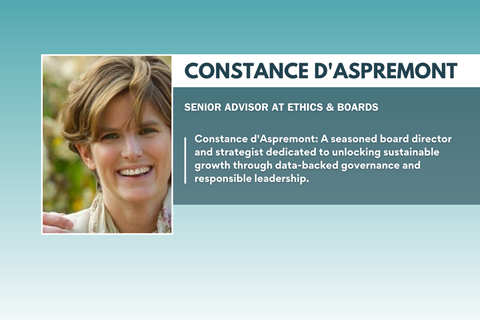
Constance d’Aspremont, Senior Advisor at Ethics & Boards.
A seasoned board director and strategist dedicated to unlocking sustainable growth through data-backed governance and responsible leadership.







23 Readers' comments