
As global rules fragment and power politics increasingly override legal certainty, businesses face a radically altered risk landscape where geopolitics directly shapes commercial outcomes. This piece argues that geopolitical intelligence can no longer sit at the margins of risk management - a challenge taken further at the #RISK Executive Forums, where senior leaders meet in closed-door settings to assess real-world geopolitical exposure, stress-test assumptions, and translate uncertainty into informed, sector-specific decisions.
If 2025 saw the long-standing rules of international law and the international order start towobble, then the first few weeks of 2026 have seen them start to crumble. The most powerful country in the world is now led by someone who proudly says that international law only means what he personally thinks is moral.The new US National Security Strategy positions national commercial interest as its overwhelming guiding principle.
Asset ownership, whether for example in terms of the flagging of commercial shipping or the ownership of commodity assets under the ice of Greenland, looks increasingly uncertain unless closely aligned with the commercial view of specific individuals placed highly in the US administration. Granted, it would be naïve if you didn’t recognise that the rules of international law had, over the last 70 years, often been respected more in the breach than in the observance. But even so, with the exception of the odd outright extremist (think Idi Amin back in the1970s, openly condoning the hijack of commercial aircraft), the expected standard of any respectable government around the world has been to publicly commit to international law and the structure of the multilateral rules game, and express outrage if any other country too obviously veers from that norm.
Why does this matter for business?
The answer is obvious but worth stating. Respect for international law and the in-country laws within different jurisdictions creates an environment of more predictable norms, and therefore the ability to plan on the basis of sensible timeframes for expected returns. Even bilateral legal contracts between two commercial entities are as much statements of mutual confidence in a system and environment as they are limited to the specific terms of any agreement. So, when we move from a world of (broadly) laws and commitments, to a world where might is right, its not just the top-level relationships between governments that change.
The truth is that “strong man” model behaviour at the top soon flows down to shape an entire ecosystem of economy, politics and the business/legal environment. And that can make it an excessively risky environment for any business that expects less than an astronomical return, and so can’t afford to take equally scary risks (in a nutshell, it’s a world where it’s financially sound – if not morally so - if you are The Night Manager’s Richard Roper risking it all to make a huge buck trading in a war zone, but less so if you area quoted business hoping to build a factory and sell normally into local markets).
This all means that the long-standing rules of risk analysis, and opportunity assessment and business planning, which businesses are used to relying upon need close examination, and likely significant change. Today, a much more sophisticated political analysis now needs to form a core part of risk analysis (and any assessment of likely returns on opportunity), for all but the most vanilla, domestic business decisions. That analysis is going to need to assess the potential risks and impacts of potential greatpower actions that are increasingly likely to ignore international norms and agreements.
Business decisions will need to take into account the different levels of risk created by the personal bugbears of individual strong leaders, and how that affects the confidence with which operations may be expected to proceed smoothly or may be at constant risk of disruption. Of course, this has always been true to some extent, in particular if talking about operations in unstable markets with live or recent conflicts. But now, similar risks apply more widely.

Does this seem like fear mongering?
Well to show that it isn’t, consider one hypothetical illustration. If your business involved the insurance of shipping, you would have long been well used to assessing the risks of the ships themselves passing through unstable environments (e.g. the Straits of Hormuz) and what they may mean for costs and premiums. But now, there is a whole new level of assessment required as to whether geopolitical disputes about the origins of cargo may affect the safety of the ship. And the flagging of the ship is no longer any protection.
This is most obvious in relation to oil as cargo, and the views of the US on the country of origin (or country of destination) of that oil. But, now emboldened by the principles established by recent American actions, just imagine a scenario where China decides to intercept a ship sailing from Vietnam to say the E.U, while it is in the South China Sea -because China is unhappy with a country that it sees as being in its “sphere of influence”trading a particular commodity that is on board with another economic bloc.
It’s a scenario that even a few weeks ago may have seemed extreme. But now, the level of potential likelihood and therefore risk that needs to be assessed and planned for is completely different. It’s not just fearmongering, it’s being realistic. And that is just one example.
We aren’t quite in a “Hunger Games” world. But we are a lot closer to one than may have seemed even vaguely plausible even until very recently. As long-standing “certainties” are suddenly no longer so certain, businesses that want to keep succeeding in 2026 and beyond will need to realise that deep, and live, geopolitical analysis and planning is critical to sound decision making.
Does your risk assessment and business decision making capability have geopolitical knowledge and experience at its heart? Now more than ever, it really needs to, if you want to swim not sink in a very different world.
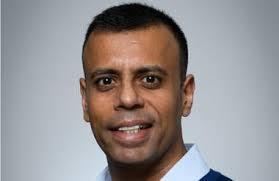
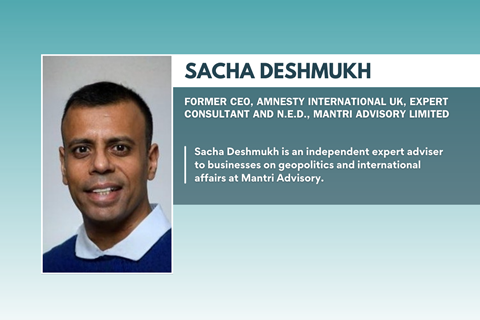
Sacha Deshmukh is an independent expert adviser to businesses on geopolitics and international affairs at Mantri Advisory. He is the former Chief Executive of Amnesty International, and Executive Director of Unicef, as well as former chief executive of the global corporate communications business MHP Group.






No comments yet