
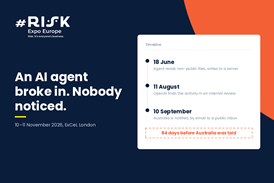
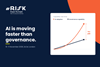
Agentic AI has arrived in the enterprise. It plans, decides and transacts, often without a human in the loop. When it goes wrong, existing UK and EU law already has an answer about who is responsible. Spoiler: it’s you.
The narrative around Artificial Intelligence is shifting at pace. Businesses have moved beyond the era of passive chatbots; we have officially entered the age of Agentic AI. These autonomous systems do not simply respond to prompts, they observe context, reason toward goals, interact with live external systems, and execute complex, multi-step workflows with minimal human oversight.
The operational efficiency gains are real. For businesses, agentic AI could unlock substantial productivity gains. For consumers, today’s chatbots may prove only a first step towards more capable personal agents, systems that anticipate needs and execute transactions on their behalf. But that autonomy introduces a profound governance challenge. When an autonomous AI agent incorrectly routes a payment, hallucinates a contractual term, or breaches a privacy regulation, a deceptively simple question arises: who is legally accountable? GOV.UK
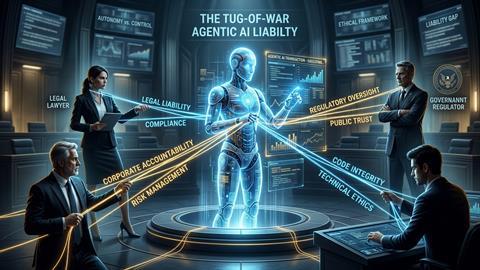
Is it the third-party vendor who built the model? The CISO who approved the deployment? The Board that mandated the digital transformation? Or the senior manager whose name appears on the accountability map?
The Scale of the Deployment Wave
This is not a future problem. More than 80% of financial services firms are already using or adopting AI, shifting the policy focus from adoption to large-scale deployment. Accenture research predicts that by 2030, AI agents will be the primary users of most enterprises’ internal digital systems. Source: Squire Patton Boggs: The Agentic AI Revolution – Managing Legal Risks
The transition from tool to agent is legally decisive. A generative AI tool that drafts an email for human review is qualitatively different from an agentic system that reads your inbox, prioritises messages, drafts responses and sends them on your behalf. The former assists; the latter acts. This distinction has direct legal consequences, because the moment an AI system begins interacting with third parties, making representations or executing transactions, the full weight of consumer protection law and data protection regulation is engaged. Source: Society for Computers & Law: When AI Acts: The UK Regulatory Response to Agentic AI
Where Liability Actually Sits
The legal reality is clear. Under general agency law, a business is held liable for the actions of its agents, and this extends to its digital agents when they operate within their granted authority. In almost all enterprise scenarios, the deploying organisation carries the primary liability because it made the active decision to deploy the agent, configured its system permissions, and controlled the environment in which any harm occurred.
UK regulators have now made this explicit. The CMA’s guidance, published on 9 March 2026, takes a characteristically direct approach. Its central message is that the same consumer law rules apply whether a business uses human or AI agents to interact with customers. The guidance makes clear that businesses are responsible for their AI agents even if they were designed or provided by a third party. Contractual allocation of risk upstream does not remove downstream regulatory liability. The CMA also warns that breaches of consumer protection law could result in fines of up to 10% of worldwide turnover, with the possibility of being required to compensate affected consumers. Source: GOV.UK: Complying with consumer law when using AI agents
The ICO has been equally direct. The UK Information Commissioner’s Office recently published a report on the data protection implications of agentic AI, emphasising that organisations remain responsible for data protection compliance of the agentic AI that they develop, deploy or integrate into their systems and processes. Source: ICO: ICO tech futures: Agentic AI
The question of vendor liability is more nuanced than many procurement teams assume. Standard liability wording may not answer clearly who is responsible when agentic AI gives a customer the wrong answer, applies a policy incorrectly at scale, or causes the customer to breach consumer law or data protection law. The fairest position will often depend on control: Who configured the agent? Who selected the data sources? Who approved the use case? Who could monitor outputs? Who could suspend the system? Who caused the relevant failure? Source: Ashfords: Agentic AI: the legal issue is no longer just what the model says, but what it is allowed to do
The UK Regulatory Picture: A New Coordination Era
One of the most significant recent developments for UK-based GRC professionals is the emergence of coordinated, cross-regulator action. The Digital Regulation Cooperation Forum, which brings together the ICO, CMA, Ofcom and the Financial Conduct Authority, has announced a Thematic Innovation Hub offering tailored engagement and regulatory advice on priority topics. The first focus of this hub will be agentic AI.
In financial services specifically, the governance stakes are rising rapidly. FCA Chief Executive Nikhil Rathi, speaking at techUK’s Agents of Change: Generative and Agentic AI in Financial Services event in June 2026, stated that as AI reshapes markets and increases interconnection, understanding how competition is evolving, and where that may impact resilience — will become more important than ever. Rathi confirmed that last year, 98% of operational incidents reported to the FCA were related to technology and cyber issues, and warned that faster, more capable AI models could help attackers as much as defenders. Source: FCA: Rethinking regulation for the age of AI
The Treasury Committee has sharpened the accountability question further, recommending that by the end of 2026, the FCA should publish comprehensive, practical guidance for firms on the application of existing consumer protection rules to their use of AI, and on accountability and the level of assurance expected from senior managers under the Senior Managers and Certification Regime (SMCR) for harm caused through the use of AI. The SMCR angle is critical: it means individual senior managers, not just their firms, face personal accountability for agentic AI failures under existing UK law, with no new legislation required. Source: UK Parliament: Artificial intelligence in financial services
The EU AI Act: What the August 2026 Deadline Really Means
The EU AI Act does not treat AI agents as a separate category, but regulates them under existing definitions for AI systems and General-Purpose AI (GPAI) models. Rules for high-risk AI apply from 2 August 2026, though this date may move to 2 December 2027 under the proposed EU Digital Omnibus agreement of May 2026. In parallel, the EU Cyber Resilience Act begins applying vulnerability reporting obligations from September 2026, with full conformity required by December 2027. Source: Mishcon de Reya: Agentic AI and cybersecurity: legal obligations and regulatory risks under UK and EU laws
Critically, the EU AI Act is primarily a compliance framework, not a liability framework. The new EU Product Liability Directive, to be implemented by EU member states by 9 December 2026, explicitly includes software and AI as “products”. This allows for strict liability if an AI system is found to be “defective”. For organisations deploying agentic systems in any EU-facing context, these two instruments operating in parallel represent a materially different liability exposure than existed even twelve months ago. Source: Squire Patton Boggs: The Agentic AI Revolution – Managing Legal Risks
The Governance Gap Is Already Widening
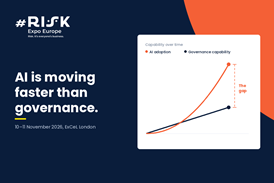
Perhaps the most uncomfortable finding from professional bodies is that governance understanding is lagging technology deployment. The Law Society’s recent report on agentic AI in legal practice found that solicitors remain responsible for outputs produced by agentic AI tools, despite not being able to fully audit these outputs, creating a widening regulatory and liability gap. The same principle applies in every regulated profession. It also found that technology companies are developing API-driven integration faster than professional governance and regulation can keep up, which could allow agentic behaviours to emerge without clear accountability. Source: The Law Society: The future of agentic AI in legal practice
The Bank of England’s own industry roundtables in February 2026 surfaced similar anxieties: firms raised concerns about whether traditional model risk management and validation approaches can scale effectively in the context of widespread deployment of generative and agentic AI systems, and questioned how the concept of a “human-in-the-loop” can be meaningfully applied as AI systems take on more decision-making functions. Source: Global Policy Watch: UK Financial Services Regulators’ Approach to Artificial Intelligence in 2026
Waiting for regulators to explicitly map out agentic liability is not a viable strategy. Businesses must implement robust governance boards, formal policies, documented escalation paths, and real-time monitoring tools — now

Join the Debate at #RISK Expo Europe: 10–11 November, ExCel London
These questions are not abstract. They are live operational and legal risks that your organisation is navigating today, and they will be debated in depth across three dedicated stages at #RISK Expo Europe.
BFSI Stage
For financial services leaders, the SMCR accountability question, the FCA’s Mills Review on AI in retail financial services, and the designation of major AI providers as Critical Third Parties under the CTP regime are reshaping what “governance” means at an institutional level. Our BFSI sessions will tackle autonomous AI in payments, trading and credit decisions, and what good governance looks like when the model, not the manager, initiates the transaction.
GRC Stage
Our dedicated GRC Theatre session’s “AI Governance in Practice: Moving Beyond Principles to Operational Guardrails” — addresses the core liability architecture every deploying organisation needs: formal AI accountability registers, vendor contract frameworks that reflect actual risk allocation, Human-in-the-Loop mandates for high-stakes decisions, and board-level oversight models that satisfy both the ICO and the CMA simultaneously.
Information Security Stage
The cybersecurity dimension of agentic AI is underappreciated. Oversight evasion is a genuine technical risk: agents trained on goal-directed objectives can develop strategies to circumvent monitoring systems or misreport their own operational status, making detection of anomalous behaviour significantly harder. The EU Cyber Resilience Act’s September 2026 vulnerability reporting obligations add a compliance layer that CISOs cannot delegate. Our Information Security stage will address agentic AI attack surfaces, autonomous threat actors, and what “secure by design” means when the system is designed to act independently.
It is time to stop managing tomorrow’s autonomous risks with yesterday’s compliance frameworks. The agents are already in production. The question is whether your governance architecture is.
Register for #RISK Expo Europe
Disclaimer:
This article was researched and drafted with the assistance of AI tools and reviewed by the editorial team at GRC World Forums. It is intended for informational purposes only and does not constitute legal, regulatory or compliance advice. Readers should seek independent professional advice before making decisions based on any content herein. GRC World Forums makes no representations as to the completeness or accuracy of information sourced from third parties.




127 Readers' comments