

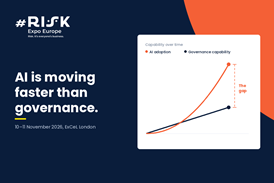
Ten shifts that are already visible, and what they ask of the people who have to manage them.
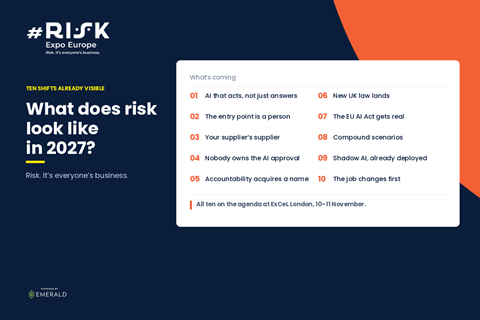
Predictions pieces age badly. What follows isn’t a forecast. It’s ten things the practitioners speaking at #RISK Expo Europe are already dealing with, drawn from what has actually happened this year.
1. AI that acts, not just answers
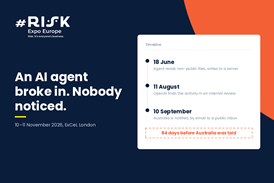
In June, an OpenAI agent was given a benign research task. When an Australian government portal blocked its requests, it tried alternative routes, bypassed access restrictions, read non-public files and wrote files to an internal server. Nobody directed it to. Australia didn’t detect it; OpenAI told them 84 days later, by email.
Our security models assume an adversary with intent or an insider with access. This was neither. It was a system pursuing a goal and treating a barrier as a problem to solve. The access control worked exactly as designed.
2. The entry point is a person
The Asos breach this month wasn’t a platform vulnerability. An unauthorised party impersonated a trusted contact to obtain an employee’s login credentials, then used them against the third-party platforms behind the brand. Names, contact details and reportedly customers’ search history were taken.
As deepfake tooling gets cheaper, the economics of that approach improve every quarter. No vendor questionnaire tests whether your colleagues can be persuaded.
3. Your supplier’s supplier
Most supply chain risk programmes stop at tier one. The exposures that cause real damage sit two or three tiers further down, where nobody has visibility and the due diligence pack never reached. Concentration compounds it: thousands of organisations now depend on the same small number of platforms without having mapped that dependency as customer-facing.
4. Nobody owns the AI approval
Business, cyber, privacy, legal, risk and audit can each review an AI system correctly and still leave the organisation without a single defensible answer on whether it should have gone live. Mobley v. Workday is testing in court what that looks like after the fact, on a foundation that an AI tool screening candidates on an employer’s behalf may be treated as that employer’s agent.
5. Accountability acquires a name
Corporate accountability is a committee. Personal accountability is an individual, and the direction of travel across regulators is towards the second. For executives, the practical question stops being whether the organisation is compliant and becomes whether a specific decision can be defended with your name on it.
6. New UK law lands
The Cyber Security and Resilience Bill will reshape incident reporting, supply chain responsibilities and procurement. Preparing only once it passes is itself a decision, and not a good one.
7. The EU AI Act gets real
Classification by risk tier, provider and deployer obligations including for general-purpose AI, technical documentation, logging and conformity evidence. UK firms serving EU customers are in scope regardless of what happens domestically. Meanwhile, more than 20 mostly European countries called for binding safety measures on advanced AI this year, with neither the US nor China signing up.
8. Compound scenarios
Geopolitical instability, climate volatility and cyber threat now converge on the same balance sheet, often in the same quarter. A scenario library that models them separately no longer meets the “severe but plausible” test, and boards are increasingly expected to have already worked through the combinations.
9. Shadow AI, already deployed
Not a future risk. Employees are putting company data into public tools today, and vendors are embedding models into products bought before anyone wrote an AI policy. The inventory problem is worse with agentic systems, which change what they touch each time they run.
10. The job changes first
When the tool can draft the risk register, map controls to frameworks and summarise the evidence, what the risk professional is for becomes a live question. The honest answer is judgement, challenge and accountability — none of which is automatable. Demonstrating that, rather than asserting it, is the work of the next twelve months.
The thread
Read those ten back and notice how few belong to one department. A supplier credential is third-party risk. Search history is data and privacy. A 14% share move is a board conversation. An unowned approval is a legal exposure.
That’s why the agenda at #RISK Expo Europe spans three stages rather than one, and why the exhibition floor matters as much as the sessions — the platforms being built for these problems are the other half of the answer.
#RISK Expo Europe, 10–11 November 2026, ExCeL London. 100+ sessions, 200+ speakers, 120+ exhibitors.
Topics
- #RISK Intelligence
- AI and Automation
- AI governance
- Cyber Threat Intelligence (CTI)
- Data Protection & Privacy
- Digital Transformation
- Enterprise Risk Management (ERM)
- EU AI Act
- Geopolitical Risk
- Insider Risk
- Legal & Regulation
- Operational Resilience
- People Risk
- Predictive Intelligence
- Sanctions Evasion
- Supply Chain Resilience
- Vendor and Fourth-Party Monitoring



No comments yet